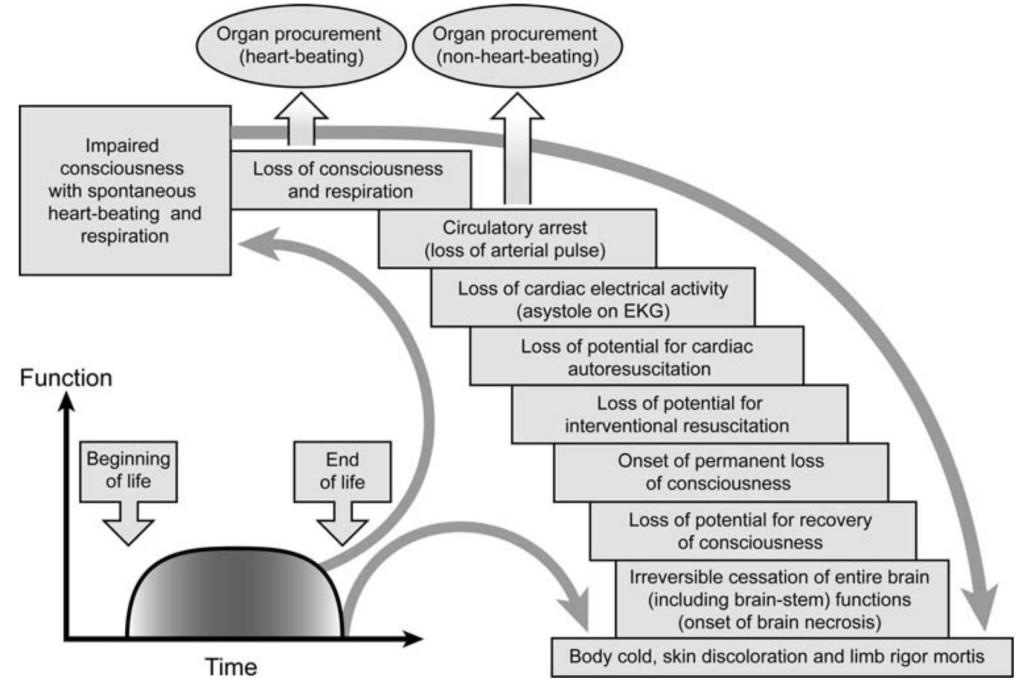
and physician-assisted death for end-of-life organ donation
and transplantation“
- 1968 – Harvard Medical School Ad Hoc Committee defined irreversible comma as a new criterion for death – this is “brain death.”
- It is currently widely accepted that brain dead patients are biologically living organisms
- Fresh, viable organs are needed for organ transplants
- Organ harvesting is a multi-billion dollar industry
- The only person who is not legally allowed to profit is the donor
- Organ harvesting companies have a financial incentive to obtain as many organs as possible for financial gain, therefore it is in their best interests to convince people to donate organs. This is an obvious conflict of interest.
- The 1968 Harvard criterion for brain death centers around 3 criteria used in bedside clinical examinations:
- Absence of brain stem reflexes
- State of comma, lack of any response to most painful stimuli
- Failure of patient to spontaneously breath as carbon dioxide levels in the blood rise (the apnea test)
- In 1981 the President’s commission approved the Uniform Determination of Death Act:
- An individual who has sustained either
- Irreversible cessation of circulatory and respiratory functions, or
- Irreversible cessation of all functions of the entire brain, including the brain stem
- Is dead
- A determination of death must be in accordance with accepted medical standards
- An individual who has sustained either
- There is no way in modern medicine to determine whether someone who is unresponsive is inwardly conscious or not
- Bedside clinical examinations are incapable of determining the irreversible loss of all brain functions
- Spontaneous movements and various stretch reflexes are considered compatible with a diagnosis of brain death.
- Brain dead patients are given anesthesia and paralytics when their organs are harvested. Why?
- The American Academy of Neurology considers persistent function of the hypothalamus (a part of the brain) compatible with a diagnosis of brain death.
- At least ½ of brain dead patients had persistent function of the hypothalamus
- At least ½ of brain dead patients had persistent function of the hypothalamus
- There have been well documented cases of patients declared brain dead who later woke up. Their families had refused to have their organs donated.
- By the late 1990’s, there were over 170 cases of chronically brain dead patients who did not immediately suffer cardiovascular collapse. They survived for weeks, months, and even years (one patient survived for over 20 years). Brain dead patients maintained PH balance, fought infection, and healed wounds. Brain dead children demonstrated proportional growth and in some cases sexual maturation. Brain dead pregnant women gestated their unborn children. These are all indications brain dead patients are alive.
- Global Ischemic Penumbra – medical condition that clinically mimics brain death. This normally lasts a couple of days, which is within the typical time that organs are harvested.
 organ donation exposed